
Commercial Tenant Improvements and Change of Occupancy in Los Angeles

Commercial tenant improvement (TI) projects are often assumed to be simple interior remodels. In reality, many commercial TI projects in Los Angeles trigger complex zoning, building code, and life‑safety requirements—particularly when a change of occupancy is involved.
Understanding when a project remains a straightforward tenant improvement—and when it crosses into change‑of‑occupancy territory—can have a significant impact on cost, scope, and schedule.
What Is a Commercial Tenant Improvement?
A commercial tenant improvement generally refers to modifications made to an existing commercial space to accommodate a new tenant or updated business operations. These changes may include:
New partitions or room layouts
Updated finishes and fixtures
Electrical, lighting, or plumbing upgrades
Mechanical system modifications
Accessibility improvements
Not all tenant improvements trigger extensive code upgrades. However, the scope of work—and more importantly, how the space will be used—ultimately determines the regulatory impact.
When a Tenant Improvement Becomes a Change of Occupancy
In Los Angeles, a change of occupancy occurs when a space shifts from one building occupancy classification to another under the California Building Code (CBC). Common examples include:
Retail to restaurant
Office to medical use
Warehouse to gym or assembly use
Manufacturing or storage to public‑facing commercial space
Even when physical changes are minimal, a change of occupancy can trigger significant requirements related to life safety, structure, accessibility, fire protection, and energy compliance.
This is often where assumptions fall apart. A space that looks similar may be regulated very differently once its use changes.
Case Study: Restaurant Tenant Improvement Within a Mixed-Use Building

Kasih, a contemporary Indonesian restaurant located at street level within the AVA Little Tokyo mixed‑use complex, illustrates how a tenant improvement can carry broader implications. The project occupies the ground floor of a seven‑story building with residences above and underground parking below, adding layers of coordination and code review.
Originally delivered as an empty shell with no prior restaurant use, the space required careful integration of commercial kitchen systems, ventilation, life‑safety separation, and accessibility upgrades. The design combines industrial exposed systems, contemporary massing, and authentic Indonesian textiles, transforming a raw space into a memorable dining environment while meeting the technical demands of a restaurant occupancy within a residential structure.
Code Implications of a Change of Occupancy
Once occupancy changes, the building—and sometimes areas beyond the tenant suite—must be evaluated against the requirements of the new use. This can include:
Fire‑Life Safety
Fire sprinkler additions or modifications
Fire alarm systems and monitoring
Rated walls, corridors, or separations
Egress and Occupant Load
Increased exit widths or additional exits
Revised travel distances
Updated door hardware and swing requirements
Structural Considerations
Higher live loads (common for gyms or assembly uses)
Seismic upgrades triggered by scope or valuation thresholds
Accessibility (ADA)
Path‑of‑travel upgrades beyond the tenant space
Restroom and fixture count changes
Mechanical and Ventilation
Increased outdoor air requirements
Kitchen exhaust, grease interceptors, or specialty systems
Because these requirements often affect shared building systems or common areas, early coordination with landlords is critical.
Zoning vs. Building Code: Two Separate Questions
A common misconception is that zoning approval alone determines whether a tenant improvement can proceed. In reality, zoning and building code address different questions:
Zoning determines whether a use is allowed on a site
Building code governs how that use must be constructed safely
A project may be fully permitted by zoning while still requiring substantial upgrades to meet building code requirements for a new occupancy.
Successful TI projects address both simultaneously.
Why Early Architectural Analysis Matters
On many commercial TI projects, code implications are discovered too late—after leases are signed, budgets are fixed, or opening dates are promised.
Early architectural involvement allows for:
Identifying hidden change‑of‑occupancy triggers
Evaluating whether existing systems can be reused
Assessing feasibility before commitments are made
Reducing permit revisions, delays, and cost escalation
In dense jurisdictions like Los Angeles, early clarity often determines whether a project moves smoothly—or stalls.
Case Study: Legalizing and Repositioning a Retail Tenant Improvement

Ziese Architecture was brought on to address unpermitted construction completed by a previous tenant within a commercial retail space in the Melrose Shopping District. During the City approval process, the building owner secured a lease with Anine Bing, a nationally recognized fashion brand.
Rather than treating the code legalization and the new tenant build‑out as separate efforts, the permit application was strategically revised to incorporate Anine Bing’s new store design alongside the required corrective work. This coordinated approach allowed the project to move through City review more efficiently, saving approximately one month in processing time.
The result was the transformation of an underutilized space into a fully permitted, refined retail environment—resolving code compliance issues while enabling a faster tenant opening.
Tenant Improvements and Adaptive Reuse Often Overlap
Commercial tenant improvements are not just technical exercises—they can also be strategic architectural tools. Thoughtful TI design can:
Unlock underutilized commercial spaces
Reposition existing buildings for modern tenants
Extend the useful life of older structures
Reduce the need for demolition or ground‑up construction
In many cases, tenant improvement and adaptive reuse overlap, particularly in legacy commercial and industrial buildings throughout Los Angeles. For more on adaptive reuse, read our article here.
Case Study: From Grocery Store to Indoor Climbing Gym
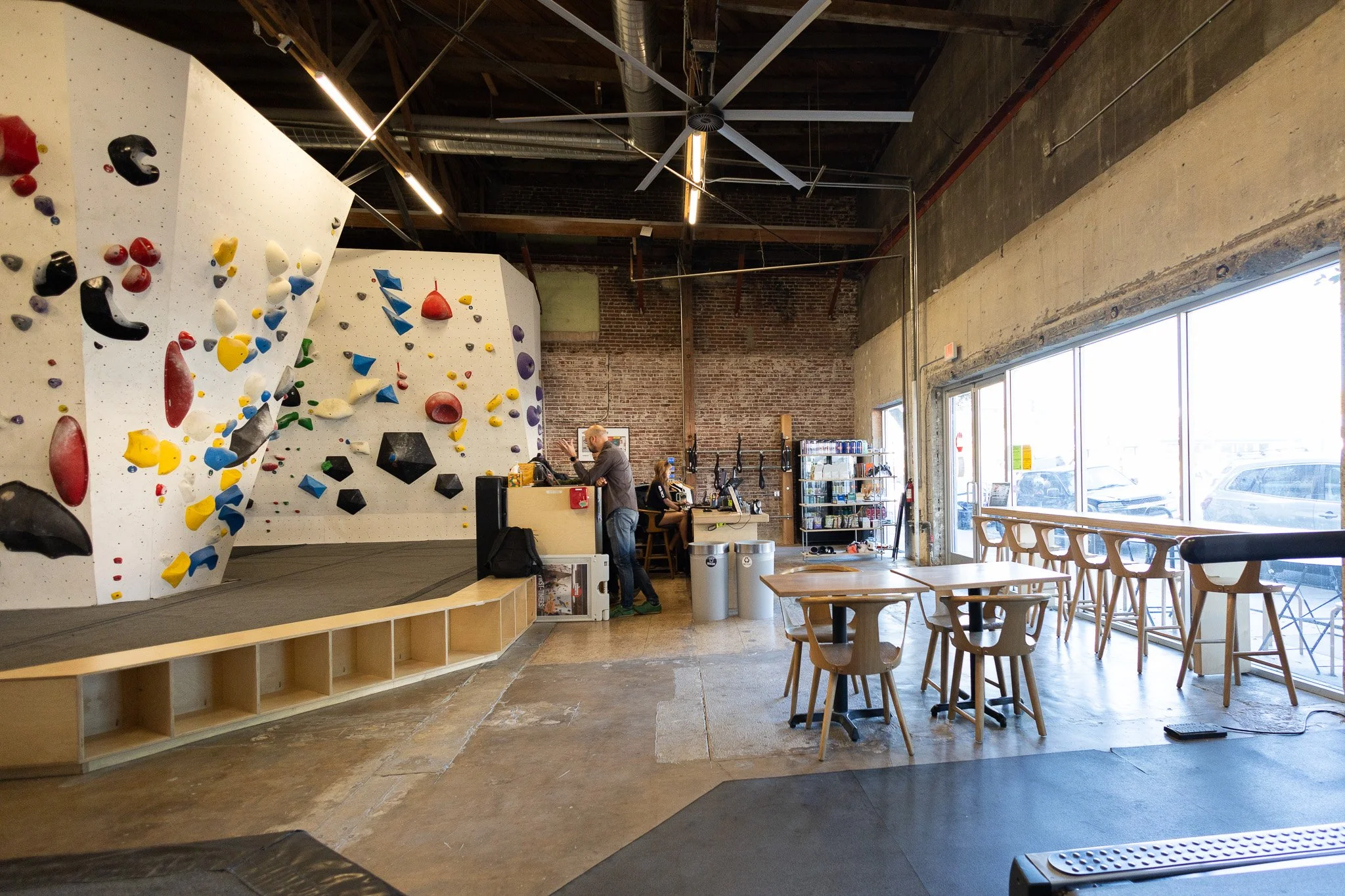
The Stronghold Echo Park project transformed a former grocery store into a modern indoor climbing gym, demonstrating how tenant improvement and adaptive reuse often intersect. While the exterior commercial shell remained largely intact, the new use introduced substantial programmatic and code requirements.
The renovation included locker rooms, restrooms, showers, office space, and comprehensive ADA upgrades, ensuring compliance with current building and life‑safety codes. Working within a more compact footprint than typical climbing gyms, the design prioritized efficient space planning while maintaining a high‑quality user experience.
The project illustrates how thoughtful adaptive reuse architecture can reposition ordinary commercial buildings into community‑oriented destinations without ground‑up construction.
Commercial Tenant Improvements Require More Than Layout Changes
While some tenant improvements are straightforward, many are not. A change of occupancy fundamentally reshapes how a project is evaluated, permitted, and constructed.
Understanding these thresholds—and designing for them early—helps tenant improvement projects move forward with fewer surprises and more realistic expectations. If you’d like to discuss your tenant improvement project, don’t hesitate to reach out to us here.